The 23-minute interruption figure is not a recovery time
Published measurements run from 599 milliseconds to 25 minutes, a spread of 2,548 times, and every one of them is correct. Four groups measured four quantities and English calls all four recovery.

On this page
The published measurements of how long it takes to get back to work after an interruption run from 599 milliseconds to 25 minutes and 26 seconds. The top of that range is 1,526 seconds, so dividing it by 0.599 gives a spread of about 2,548 times, and every number in it is correct. Four research groups measured four different quantities, and English calls all four “recovery”.
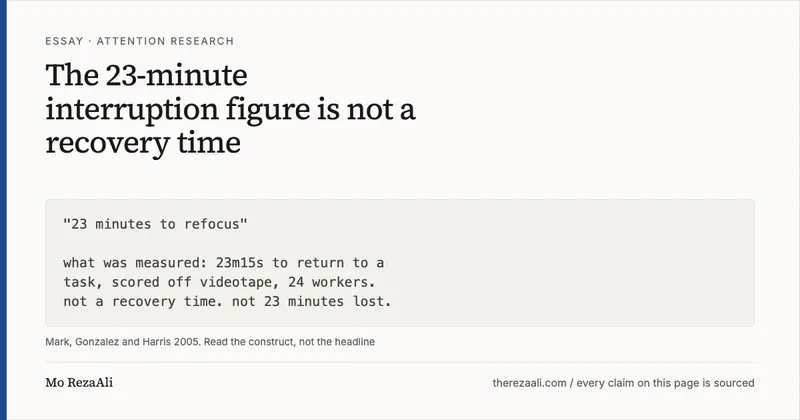
The most quoted figure in this subject is not among them, because it is not from a paper. “It takes 23 minutes and 15 seconds to refocus after an interruption” originates in a Gallup Business Journal interview with Gloria Mark, published 8 June 2006. What she describes it as measuring is elapsed time until interrupted work was resumed, conditioned on the 81.9 percent of cases where it was resumed the same day at all, and counting minutes in which the person was working productively on roughly two other things. Her own assessment of it, in the sentence that produces it, is “which I guess is not so long.”
The published figure from the same research programme, Mark, Gonzalez and Harris at CHI 2005, is 25 minutes and 26 seconds, with a standard deviation of 54 minutes and 48 seconds. The deviation is more than twice the mean, so the distribution is not summarised by its average, and no article I have seen quoting 23 minutes has mentioned it. An independent citation audit checked five commonly cited papers for the 23-minute figure and found it in none of them. I pulled the two primary PDFs and confirm the same.
Table: What four primary studies actually measured. All four get reported in popular writing as recovery time after an interruption.
| Construct measured | Study | Value |
|---|---|---|
| Extra delay before the first action on resuming a suspended goal | Monk, Trafton and Boehm-Davis, JEP: Applied 2008, lab task | 599 ms |
| Return to the prior work rate, scored off videotape | Jackson, Dawson and Wilson, EASE 2002, 16 employees, 28 days | 64 s |
| Return to the application holding the primary task after an email alert | Iqbal and Horvitz, CHI 2007, 27 users, instrumented | 9 min 33 s |
| Elapsed clock time until the thread of work resumed, same day only | Mark, Gonzalez and Harris, CHI 2005, 24 workers, 700+ hours | 25 min 26 s |
These are not substitutes. 599 ms is a memory retrieval cost, and it is a difference rather than a duration. Nobody in that experiment waited 599 milliseconds and then carried on. Monk, Trafton and Boehm-Davis measured a mean resumption lag of 1,548 ms (SD 231) after an interruption against a mean interval of 949 ms (SD 283) between actions on uninterrupted trials, and report the gap between the two as “an estimated cost of 599 ms on the VCR programming task.” Quote either number and you are right; quote them as the same number and you are not. 64 seconds is a behavioural recovery. 9 minutes 33 seconds is a navigation delay, and Iqbal and Horvitz say so themselves: their measure is application access, “not resumption of a suspended task.” 25 minutes 26 seconds is a scheduling statistic that includes 2.26 other working spheres of real work.
The post I wrote, and what was missing from it
I published a post saying I had spent years treating responsiveness as productivity, that some of my busiest days produced almost nothing that mattered, and that my most productive weeks were the ones where I disappeared for a few hours a day with no Slack, no meetings and no email. That post is here. All of it is my own first-person recollection, unaudited, with no output metric behind it. I never measured a before or an after. That is exactly the shape of a post-hoc success story, so the useful work is finding out which parts of it survive contact with people who did measure.
One phrase survives, conservatively. I wrote “context switches every few minutes.” The CHI 2005 field data puts an average working sphere at 11 minutes 4 seconds before a switch. The earlier study it builds on, Gonzalez and Mark at CHI 2004, timed the finer unit and found 3 minutes 8 seconds of continuous work on a single event, with formal meetings and personal time excluded from that average.
Interrupted work gets finished faster
Mark, Gudith and Klocke, CHI 2008, titled “The Cost of Interrupted Work: More Speed and Stress”, is the paper most often cited for the proposition that interruptions destroy productivity. On the productivity measure it found the opposite. Subjects answered a fixed set of emails, interrupted every two minutes by phone or instant message, with the time spent on the interruptions themselves subtracted out.
Table: Completion time and reported stress in Mark, Gudith and Klocke, CHI 2008. Stress is a 20-point scale.
| Condition | Completion time | Stress |
|---|---|---|
| No interruption | 22.77 min | 6.92 |
| Interrupted, same context | 20.31 min | 9.46 |
| Interrupted, different context | 20.60 min | 9.13 |
Both interrupted conditions were significantly faster than the uninterrupted one. There was no significant difference in errors and none in politeness. Emails fell from 31.49 words when uninterrupted to 29.17 when interrupted, a significant drop. Frustration, time pressure and effort all rose significantly. The authors’ own reading: people “develop a mode of working faster (and writing less) to compensate.”
Two things must travel with that result or it misleads. The study ran 48 subjects, 81 percent of them German university students with a mean age of 26, in a 1.5-hour laboratory session, not a field study of information workers. And the authors flag the alternative they could not rule out: the lost time may occur only in the moments right after each interruption and be masked by the faster overall style, which would need more sensitive measurement to see.
The correction still holds and it is the useful part. Fragmented time produces output, faster, at equal accuracy, and shorter. The cost is not throughput. It is paid in stress load and in elaboration. My post said the work that matters “doesn’t happen during the ten minutes between two meetings,” and anyone who has cleared an inbox in ten minutes knows that is false as stated. What is true and sourced is that what you produce in ten minutes is systematically shorter and costs you more to produce.
The mechanism
Goals are not stored on a stack that you pop back to. Altmann and Trafton’s activation-based model in Cognitive Science treats a goal as a memory item whose activation decays over time and suffers retroactive interference from goals encoded after it, with retrieval depending on cues in the environment. That is why 2.26 intervening working spheres cost more than 25 minutes of clock time does, and why Mark’s informants reported real difficulty when windows or papers had been rearranged during their absence: the retrieval cue was gone, so the pending goal had nothing to be reinstated by.
The second mechanism is attention residue. Leroy, in Organizational Behavior and Human Decision Processes, found across two experiments that people “need to stop thinking about one task in order to fully transition their attention and perform well on another,” and then reports the part most productivity writing has backwards: finishing the prior task is not sufficient. Time pressure while finishing it is what enables the disengagement. A task you completed calmly can leave more residue than one you completed against a deadline.
That answers why my busy days produced nothing, and the answer is not that I did no work. I did a great deal of work, quickly, and it was short. The analysis sitting in drafts was the item whose activation had decayed furthest, because it was the only one with no external cue demanding it be reinstated.
How to detect this in your own system
Count switches, not pings. Microsoft’s June 2025 Work Trend Index says employees are interrupted every two minutes during core work hours, 275 times a day, by meetings, emails or chats. Read its methodology note before quoting either number. The two figures are measured over different windows and Microsoft says so in consecutive sentences: “The two-minute figure reflects the average time between pings during an eight-hour workday. The 275 is based on the 24-hour day.” Then comes the sentence that almost never travels with the statistic: “Based on the top 20% of users by ping volume received.” So 275 is not the average worker’s day. It is a 24-hour count for the most-pinged fifth of users, and it is not divisible into an 8-hour one. What is measured underneath is “a rolling 28-day sum of pings (meeting invites, emails, chats) per unique user per workday”, which counts what arrived, not what pulled you out of what you were doing. Your own equivalent is the count of times you changed context, which no dashboard reports and which you have to sample by hand.
Measure your internal-to-external ratio before you buy a solution. In Mark’s CHI 2005 data, 48 percent of interruptions were external and 52 percent were self-initiated, and among analysts and developers the two ran roughly equal. Every calendar-blocking remedy, including the one I recommended in my post, addresses the external 48 percent.
Check whether alerts actually move you. Iqbal and Horvitz found only 40.8 percent of email alerts produced a switch to the mail client within 15 seconds; the other 59.2 percent averaged 7 minutes 32 seconds first, which the authors read as self-initiated. Jackson, Dawson and Wilson, watching 180 hours of videotape, found 70 percent of emails reacted to within 6 seconds of arrival. People already treat most alerts as deferrable, and unreliably.
Separate interruption from context change. This is the sharpest rule in the literature and I did not have it. Mark’s informants described interruptions inside their current working sphere as “interactions” and reported them as beneficial, one analyst describing a problem continuing to develop in the background while not being worked on. What they called disruptive was being forced out of the current sphere. The cost is in the context change.
How to design so it cannot recur
Preserve the retrieval cue. Altmann and Trafton’s model makes the workspace itself part of the memory system, so leaving the file open, the terminal on the failing test and the note half-written is the cheapest intervention available, and it costs nothing.
Do not assume a blocked calendar solves it. In the same Gallup interview that produced the 23-minute figure, Mark describes getting a three-hour block, closing her office door, spending the entire block on small accumulated tasks and touching none of the paper she had reserved it for. Her own diagnosis: “I interrupted myself. I kept interrupting myself.” That is the honest limit on the prescription I gave, from the researcher who measured the problem.
Be careful what you claim for batching. Kushlev and Dunn ran 124 people, one week limited to three email checks a day against one week unlimited, and found significantly lower daily stress in the limited week, F(1,121)=4.18, p=.04, d=.37. Mark and colleagues at CHI 2016 logged 40 people over 12 workdays with heart-rate monitors and state that “despite widespread claims, we found no evidence that batching email leads to lower stress.” I would bet on the second, and the reason is in the details. Kushlev and Dunn’s effect appears on a single-item daily stress question but not on the validated weekly Perceived Stress Scale, where the two conditions sit at 1.68 and 1.67 with d=.04. The sample was roughly two thirds students, there was no control condition, and the distraction effect was significant for students and absent for community members. Mark’s team measured physiologically, in situ, on working adults. When a daily self-report and a biosensor disagree, the self-report is the measure that knows which condition it is in.
Design the block for elaboration, not for volume. Since interrupted work comes out faster and shorter at equal accuracy, protected time is for the work whose quality lives in its length: the argument that needs a fourth paragraph, the analysis that needs its caveat, the problem that needs a wrong approach tried first.
What I have now that I did not have before
A rule that discriminates, in place of a rule that generalises. My post said to protect attention, which is true and unactionable. What I run instead is a test on context change: an interruption that keeps me inside the current working sphere is nearly free and sometimes useful, and one that moves me out of it is the expensive event, whatever it cost in wall-clock minutes.
I also have a number I will not use. When I next see 23 minutes and 15 seconds in a deck, I know where it came from, what it measured, that the researcher who produced it called it not so long, and that the peer-reviewed version is 25 minutes 26 seconds with a standard deviation twice its own size. The figures that circulate most are the ones that have travelled furthest from what was actually measured, and the provenance is worth more than the number.
Sources
Every source below was opened and checked on the date shown. Links open in this tab.
- I Thought Being Available Made Me Productive. I Was Wrong. Mo RezaAli on X x.com Accessed 6 August 2026
- Too Many Interruptions at Work? Gallup Business Journal, interview with Gloria Mark, 8 June 2006 news.gallup.com Accessed 6 August 2026
- No Task Left Behind? Examining the Nature of Fragmented Work CHI 2005, Mark, Gonzalez, Harris ics.uci.edu Accessed 6 August 2026
- "Constant, Constant, Multi-tasking Craziness": Managing Multiple Working Spheres CHI 2004, Gonzalez, Mark ics.uci.edu Accessed 6 August 2026
- The Cost of Interrupted Work: More Speed and Stress CHI 2008, Mark, Gudith, Klocke ics.uci.edu Accessed 6 August 2026
- Case Study: Evaluating the Effect of Email Interruptions within the Workplace EASE 2002, Jackson, Dawson, Wilson interruptions.net Accessed 6 August 2026
- Disruption and Recovery of Computing Tasks: Field Study, Analysis, and Directions CHI 2007, Iqbal, Horvitz, Microsoft Research www.microsoft.com Accessed 6 August 2026
- The Effect of Interruption Duration and Demand on Resuming Suspended Goals Journal of Experimental Psychology: Applied 2008, Monk, Trafton, Boehm-Davis www.interruptions.net Accessed 6 August 2026
- The Effect of Interruption Duration and Demand on Resuming Suspended Goals (record) PubMed, National Library of Medicine pubmed.ncbi.nlm.nih.gov Accessed 6 August 2026
- Memory for goals: an activation-based model Cognitive Science 26, 2002, Altmann, Trafton www.interruptions.net Accessed 6 August 2026
- Why is it so hard to do my work? The challenge of attention residue when switching between work tasks Organizational Behavior and Human Decision Processes 2009, Leroy doi.org Accessed 6 August 2026
- Why is it so hard to do my work? (bibliographic record) RePEc IDEAS, Elsevier ideas.repec.org Accessed 6 August 2026
- Breaking down the infinite workday Microsoft Work Trend Index special report, June 2025 www.microsoft.com Accessed 6 August 2026
- Email Duration, Batching and Self-interruption: Patterns of Email Use on Productivity and Stress CHI 2016, Mark, Iqbal, Czerwinski, Johns, Sano www.microsoft.com Accessed 6 August 2026
- Checking email less frequently reduces stress Computers in Human Behavior 2015, Kushlev, Dunn www.interruptions.net Accessed 6 August 2026
- It takes 23 minutes and 15 seconds to refocus after an interruption blog.oberien.de, citation audit blog.oberien.de Accessed 6 August 2026