Writing
Articles on search, analytics and automation. Every claim carries a source, and the build refuses to publish if any of them stops resolving.
19 articles, citing 298 distinct sources. Every one of them is fetched when this site builds, and the build fails if any stops answering.
Every article here lists its sources, states plainly what it does not cover, and says how confident I am in it. Those are not editorial promises. A check runs on every build and refuses to publish the site if a single cited URL stops answering, which is the only version of that promise worth making.
If you read one thing, make it what a quality gate cannot see. It works through a failure mode that is not really about writing: an automated evaluator that scores what it can detect on the surface will get the surface and nothing under it, and the same defect sits inside a rubric scored by a language model, a brief written around keywords, and a scorecard that counts tests instead of running them. I met it at a scale most people do not, on this domain, and the article is the mechanism and the fix rather than the anecdote.
Articles are in English. The pages that explain who I am and how I work are also in Italian.
2026
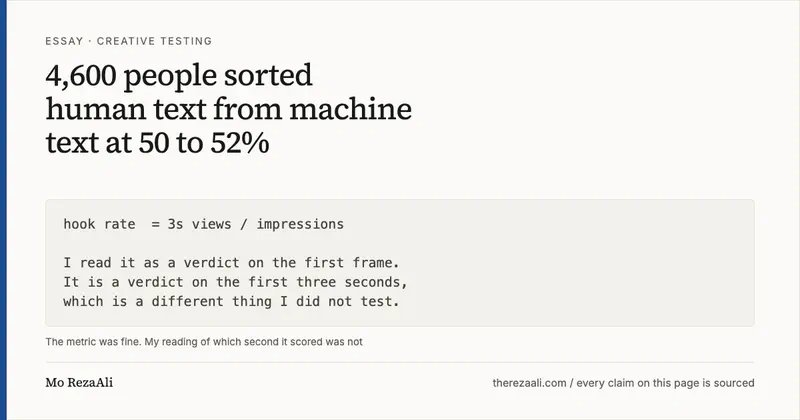
4,600 people sorted human text from machine text at 50 to 52%
Polish is not a detection cue, because detection barely happens. The rougher cut of my ad did win on hook rate, and I had explained why it won incorrectly.
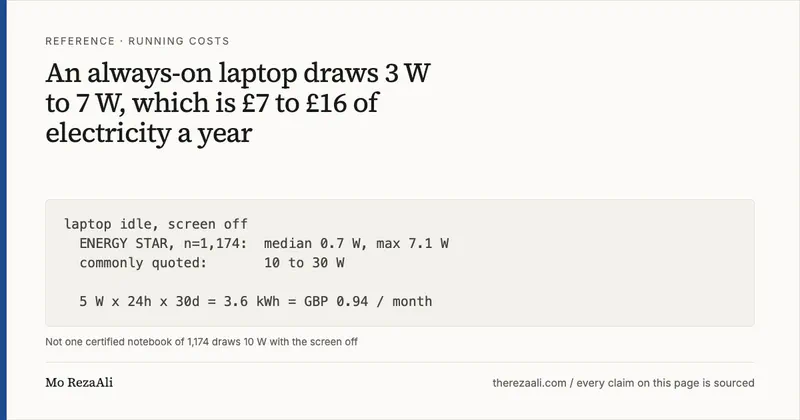
An always-on laptop draws 3 W to 7 W, which is £7 to £16 of electricity a year
The guess I inherited was 10 W to 30 W. The certified data puts it at 3 W to 7 W: £7 to £16 a year, four or five dollars of model spend, and $0 in licences at this scale.
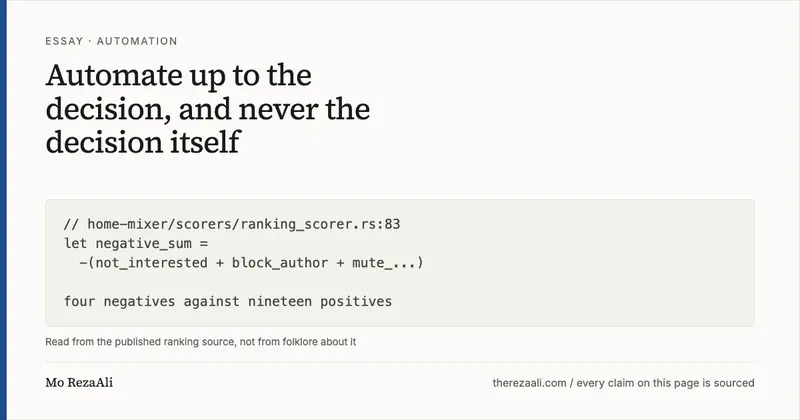
Automate up to the decision, and never the decision itself
X’s ranker exposes nineteen prediction heads. None is an impression, four are negative, and net-negative posts leave through a different branch. Three automations I killed, eleven I kept.
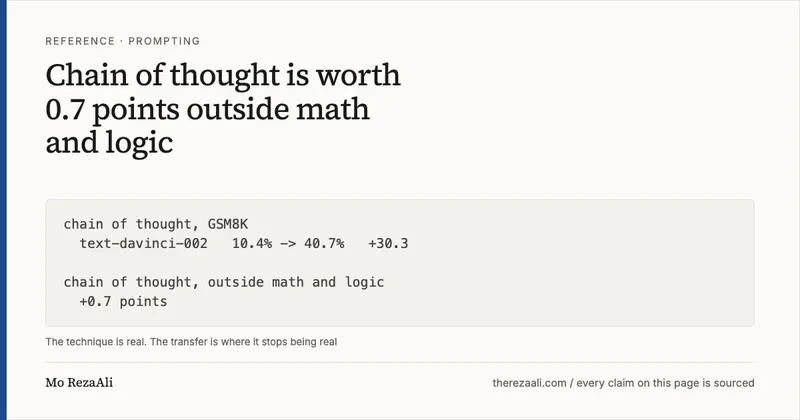
Chain of thought is worth 0.7 points outside math and logic
A meta-analysis over more than 100 papers: 12.3 points on math, 0.7 on everything else, 56.8 against 56.1. What that leaves of three techniques people still sell.
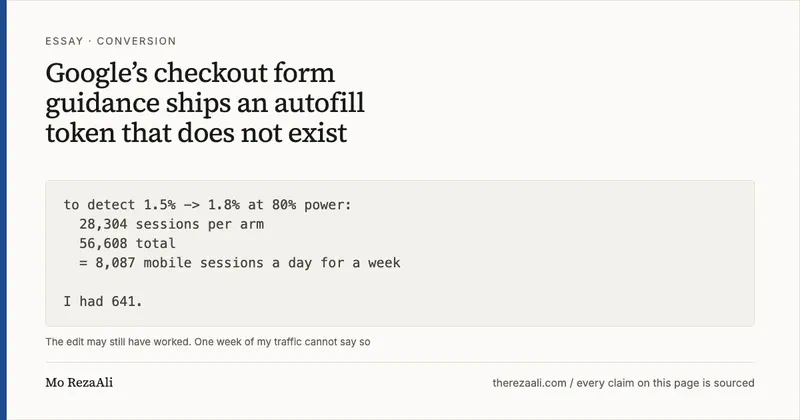
Google’s checkout form guidance ships an autofill token that does not exist
The string address-line-1 appears five times on web.dev, four of them inside an autocomplete attribute. Also the single-column study that excluded mobile, and why device conversion splits are partly artifact.
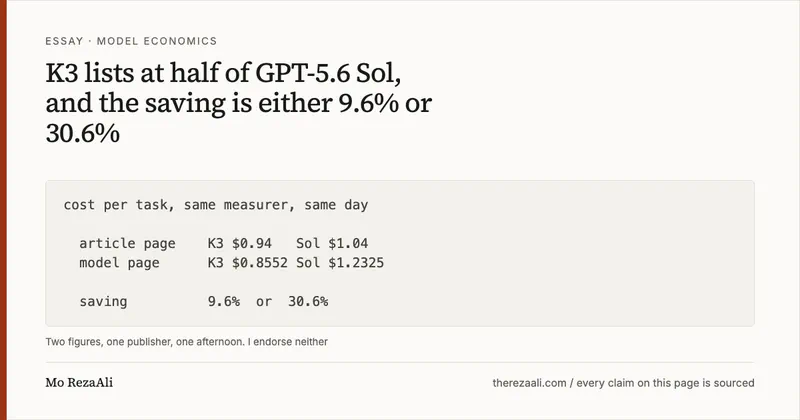
K3 lists at half of GPT-5.6 Sol, and the saving is either 9.6% or 30.6%
Artificial Analysis publishes both figures, for the same metric and the same two models, on two of its own pages on the same day. Both are in the table. Neither is endorsed here.
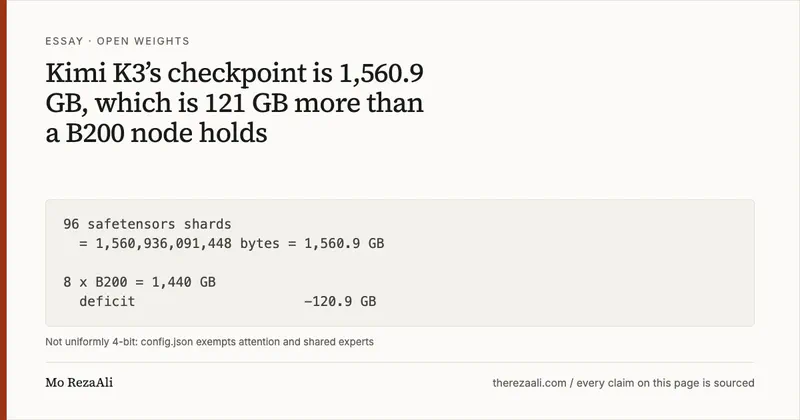
Kimi K3’s checkpoint is 1,560.9 GB, which is 121 GB more than a B200 node holds
The model card says 2.8 trillion parameters at four bits, which multiplies out to 1,400 GB. The uploaded weights are 1,560.9 GB, because a 4-bit release is not uniformly four bits.
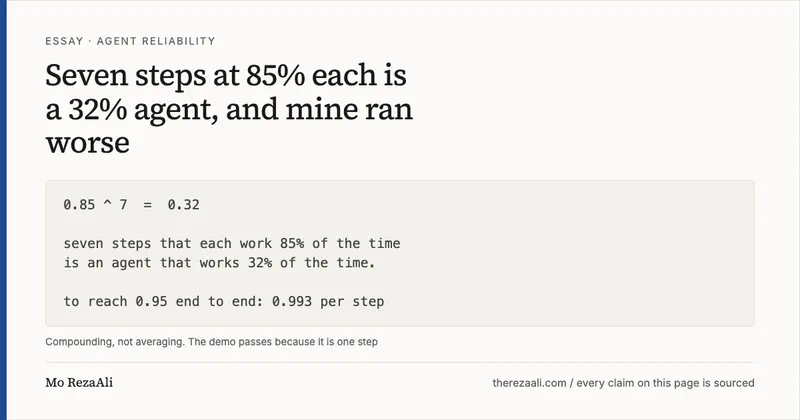
Seven steps at 85% each is a 32% agent, and mine ran worse
0.85 to the seventh is 0.3206, and no prompt or model upgrade changes it. My seven-node cart agent modelled at 48% end to end and ran at about one in five. The gap is the useful part.
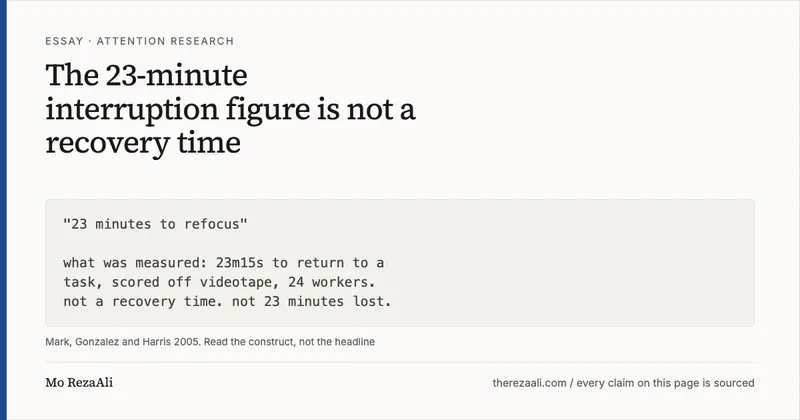
The 23-minute interruption figure is not a recovery time
Published measurements run from 599 milliseconds to 25 minutes, a spread of 2,548 times, and every one of them is correct. Four groups measured four quantities and English calls all four recovery.
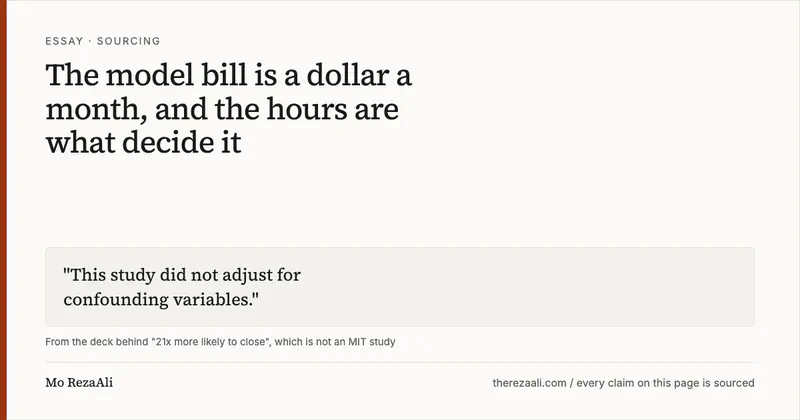
The model bill is a dollar a month, and the hours are what decide it
A CVSS 9.3 row-level-security record against the build tool, Gmail’s 0.3% spam ceiling, and GDPR Article 28(4). Then the arithmetic on the line that sets the margin.
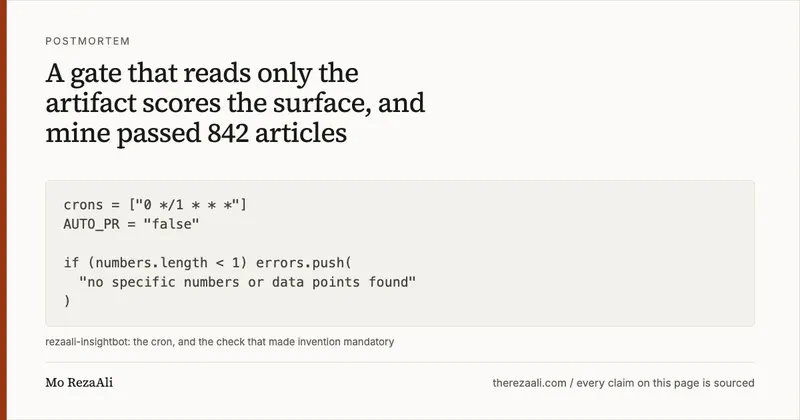
A gate that reads only the artifact scores the surface, and mine passed 842 articles
LLM-as-judge rubrics and keyword briefs carry the same defect. The source of a gate that had it, and seven checks that find it in yours.
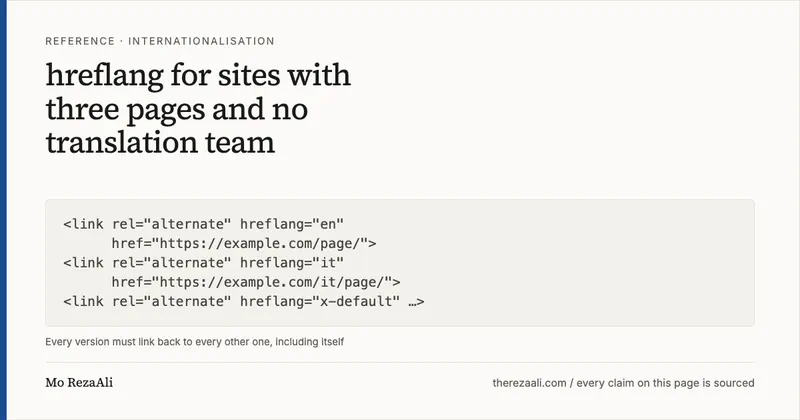
hreflang for sites with three pages and no translation team
The return-link rule, x-default, and the code formats that fail silently. Then the measured state of the 2,183 machine-translated pages I had pointed them at.
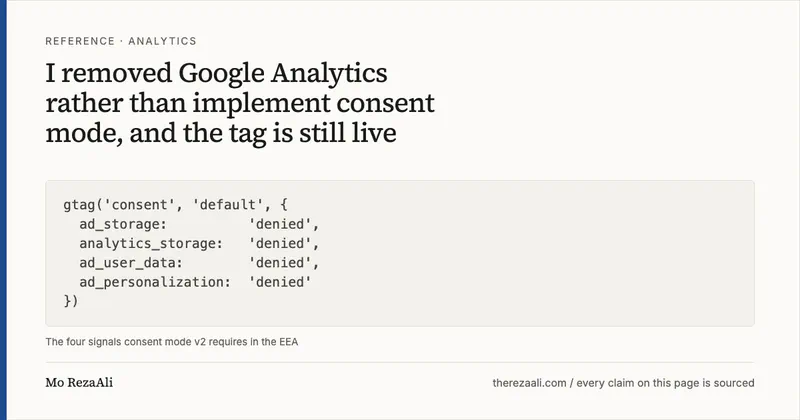
I removed Google Analytics rather than implement consent mode, and the tag is still live
What consent mode v2 requires of a one-person EU site, what running it properly costs, and the least flattering part of my own reasoning.
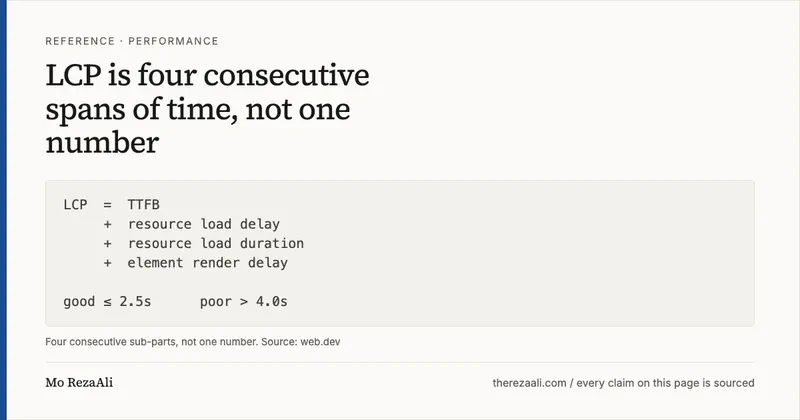
LCP is four consecutive spans of time, not one number
Until you know which of the four is eating the budget, you are guessing at which fix to apply. Four checks for a static site, each with the command that finds the problem.
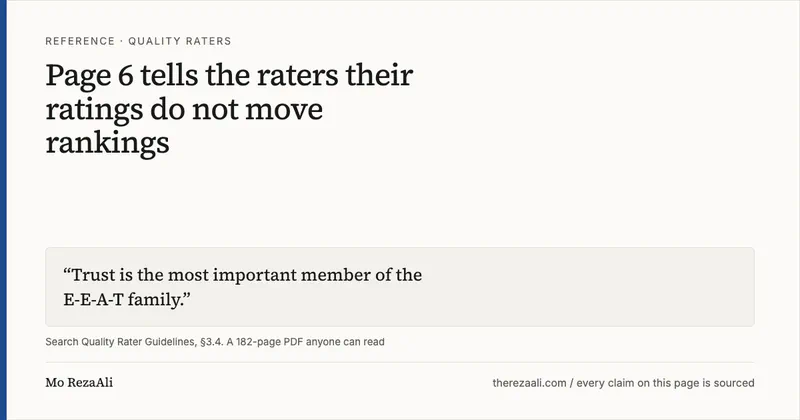
Page 6 tells the raters their ratings do not move rankings
The quality rater guidelines run to 182 pages, carry the date 11 September 2025, and cost nothing to download. They name Trust as the most important member of E-E-A-T. Quoted from the PDF.
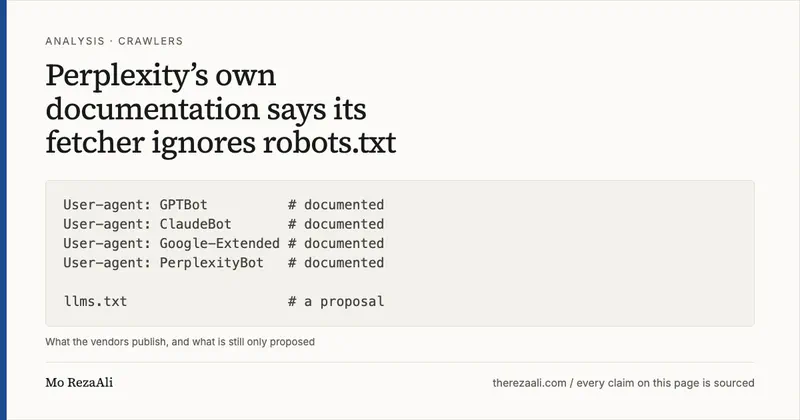
Perplexity’s own documentation says its fetcher ignores robots.txt
The vendor’s words, not a critic’s. Where the line falls between training crawlers and answer-time fetchers, what each of the four big vendors documents, and the manifests I got wrong.
Seven things a comparison site publishes that you can check from outside
You are not in the room and cannot audit what was tested. These come from the methodologies of Wirecutter, Consumer Reports, G2 and Tom’s Hardware, and I graded my own deleted benchmark against them.
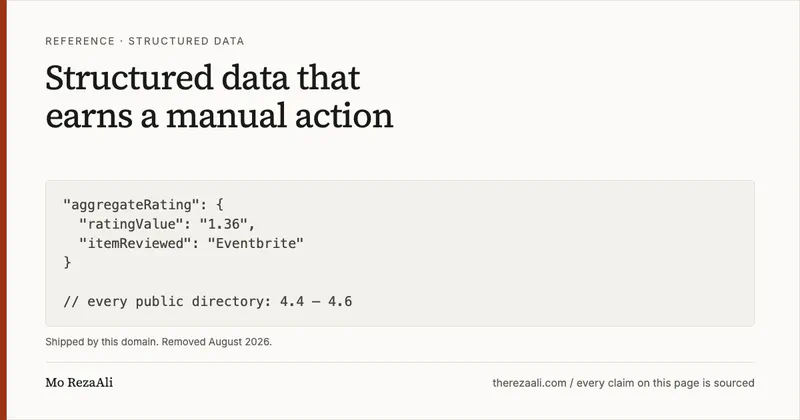
Structured data that earns a manual action
Apple publishes 4.9 and 4.89705 for the same app within one hour. Six conditions markup has to meet to stay inside the guidelines, and four public directories read on one day.
The scaled content abuse policy does not ban AI writing
It bans generating many pages to manipulate rankings, “no matter how it’s created”. The policy in full, then the strongest argument that the distinction cannot be applied.